Top VR Development Tools in 2026
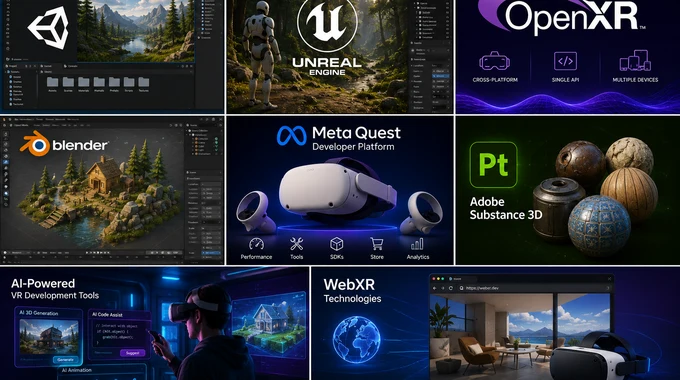
Virtual Reality (VR) technology is growing faster than ever in 2026. What was once mainly associated with gaming has now expanded into industries like education, healthcare, manufacturing, architecture, retail, training, and business collaboration. Companies across the world are investing heavily in immersive technologies to improve learning, engagement, visualization, and productivity.

As VR adoption continues to increase, the demand for powerful VR development tools is also rising. Developers now have access to advanced game engines, AI-powered workflows, cross-platform XR frameworks, and 3D content creation software that make building immersive experiences more efficient and scalable.
Whether it is an educational VR platform, a virtual training simulation, a real estate walkthrough, or an interactive business application, choosing the right development tools plays a major role in the success of any immersive project.
In this blog, we will explore some of the top VR development tools in 2026 that are helping developers and businesses create the future of immersive experiences.
1. Unity
Unity continues to remain one of the most widely used VR development platforms in 2026. Its popularity comes from its flexibility, user-friendly workflow, large community support, and ability to develop applications for multiple VR platforms.
Developers use Unity for creating educational simulations, immersive learning platforms, VR training applications, virtual tours, multiplayer VR experiences, and much more. The engine supports major VR ecosystems including Meta Quest, HTC Vive, Pico, and Windows Mixed Reality devices.
One of the biggest advantages of Unity is its balance between performance and accessibility. Even smaller teams and startups can build high-quality VR applications without needing extremely large production budgets.
Key Features of Unity
- Cross-platform VR deployment
- XR Interaction Toolkit
- Real-time rendering engine
- OpenXR integration
- Large asset marketplace
- Strong developer community
Unity is especially popular in the education sector where immersive learning experiences are becoming increasingly important for improving student engagement and understanding.
2. Unreal Engine
Unreal Engine has become one of the leading tools for creating visually advanced and photorealistic VR experiences. In 2026, it is widely used in industries where visual quality is extremely important, including architecture, automotive visualization, cinematic storytelling, industrial simulation, and AAA gaming.
The engine’s advanced rendering systems allow developers to build highly immersive environments with realistic lighting, textures, shadows, and physics. Technologies like Lumen and Nanite have significantly improved real-time graphics performance while maintaining high visual quality.
Although Unreal Engine is often considered more advanced compared to other engines, it offers incredible flexibility and power for developers aiming to create premium immersive experiences.
Key Features of Unreal Engine
- Photorealistic rendering capabilities
- Lumen dynamic lighting system
- Nanite virtualized geometry
- Blueprint visual scripting
- Advanced animation and physics tools
- High-end cinematic visuals
For companies that prioritize realism and immersive visual experiences, Unreal Engine remains one of the strongest choices in the VR industry.
3. OpenXR
OpenXR has become an essential part of modern VR development because it helps solve compatibility challenges between different VR hardware ecosystems. Earlier, developers often needed separate integrations for different VR devices, which increased complexity and development time.
OpenXR provides a standardized and vendor-neutral framework that allows developers to build applications compatible with multiple VR and XR platforms through a single workflow.
This standardization is helping the VR industry become more scalable and future-ready while reducing development costs and technical limitations.
Benefits of OpenXR
- Cross-platform compatibility
- Vendor-neutral development framework
- Reduced hardware dependency
- Improved scalability
- Future-proof XR development
As immersive technologies continue to evolve, OpenXR is expected to become even more important for creating flexible and scalable XR applications.
4. Blender
Blender continues to play a major role in VR content creation workflows. Since immersive experiences depend heavily on 3D environments, characters, animations, and objects, high-quality content creation tools are essential for developers and designers.
Blender has become one of the most popular open-source 3D software solutions because it offers professional-level features without expensive licensing costs. It is widely used by indie creators, startups, educational institutions, and enterprise studios.
Key Features of Blender
- 3D modeling tools
- Animation and rigging systems
- Environment creation
- Sculpting tools
- Visual effects support
- Real-time rendering
Blender’s growing community and constant improvements continue to make it one of the most valuable tools in immersive content production.
5. Meta Quest Developer Platform
Meta continues to dominate the standalone VR market through its Quest ecosystem. In 2026, Meta Quest devices are widely used not only for gaming but also for immersive learning, employee training, healthcare simulations, and virtual collaboration.
The Meta Quest Developer Platform provides developers with advanced tools for creating interactive VR and mixed reality experiences optimized specifically for Quest devices.
Key Features of Meta Quest Platform
- Hand tracking support
- Mixed Reality capabilities
- Spatial anchor systems
- Standalone VR optimization
- Advanced interaction tools
As standalone VR becomes more affordable and accessible, Quest devices are expected to continue driving global VR adoption.
6. Adobe Substance 3D
Immersion in VR depends greatly on visual realism and environmental detail. Adobe Substance 3D has become one of the leading tools for creating highly realistic textures and materials for immersive environments.
Developers use Substance 3D to design detailed surfaces, realistic materials, and physically based rendering textures that improve the visual quality of VR experiences.
Key Features of Adobe Substance 3D
- Procedural material generation
- Advanced texture painting
- PBR workflow support
- Realistic surface detailing
- Integration with 3D pipelines
Substance 3D is commonly used in gaming, architecture visualization, simulation training, and immersive product design.
7. AI-Powered VR Development Tools
Artificial Intelligence is becoming one of the biggest trends in VR development in 2026. AI-powered tools are helping developers automate repetitive tasks, generate content faster, and improve overall productivity.
Developers are now using AI for generating 3D assets, creating intelligent NPCs, automating animations, improving voice interactions, and assisting with coding workflows.
Popular AI Use Cases in VR
- AI-generated 3D environments
- Smart NPC interactions
- Voice-enabled experiences
- Automated animations
- AI-assisted development workflows
The combination of AI and XR technologies is expected to play a major role in shaping the future of immersive digital experiences.
8. WebXR Technologies
WebXR is becoming increasingly important because it allows users to experience immersive applications directly through web browsers without downloading separate apps.
This approach improves accessibility and makes it easier for businesses and educational platforms to deliver immersive experiences across multiple devices.
WebXR technologies are particularly useful for virtual events, online learning platforms, interactive product showcases, and lightweight immersive applications.
Popular WebXR Frameworks
- Three.js
- A-Frame
- Babylon.js
As browser capabilities continue to improve, WebXR is expected to become a larger part of the immersive technology ecosystem.
Future of VR Development
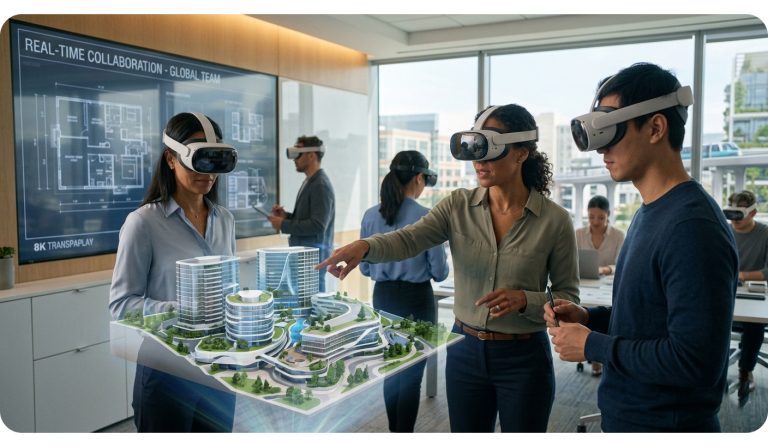
The future of VR development is moving toward more intelligent, connected, and accessible immersive experiences. Technologies like spatial computing, mixed reality, AI-generated environments, and cloud-based XR systems are reshaping how users interact with digital content.
Educational institutions are adopting immersive learning platforms to improve understanding and engagement, while enterprises are using VR for employee training, virtual collaboration, and operational simulations.
As hardware becomes more affordable and development tools become more creator-friendly, immersive technology is expected to become a standard part of digital interaction in the coming years.
Conclusion
VR development tools in 2026 are more powerful, accessible, and scalable than ever before. Platforms like Unity, Unreal Engine, OpenXR, Blender, Meta Quest, and AI-powered solutions are helping developers create immersive applications across education, healthcare, business, gaming, and enterprise industries.
Choosing the right VR development tools depends on project goals, performance requirements, scalability, visual quality, and target platforms. Businesses and developers investing in immersive technologies today are positioning themselves strongly for the future of digital experiences and spatial computing