VR Training for Construction: Cut Costs and Risk
 By Miheer Jasani
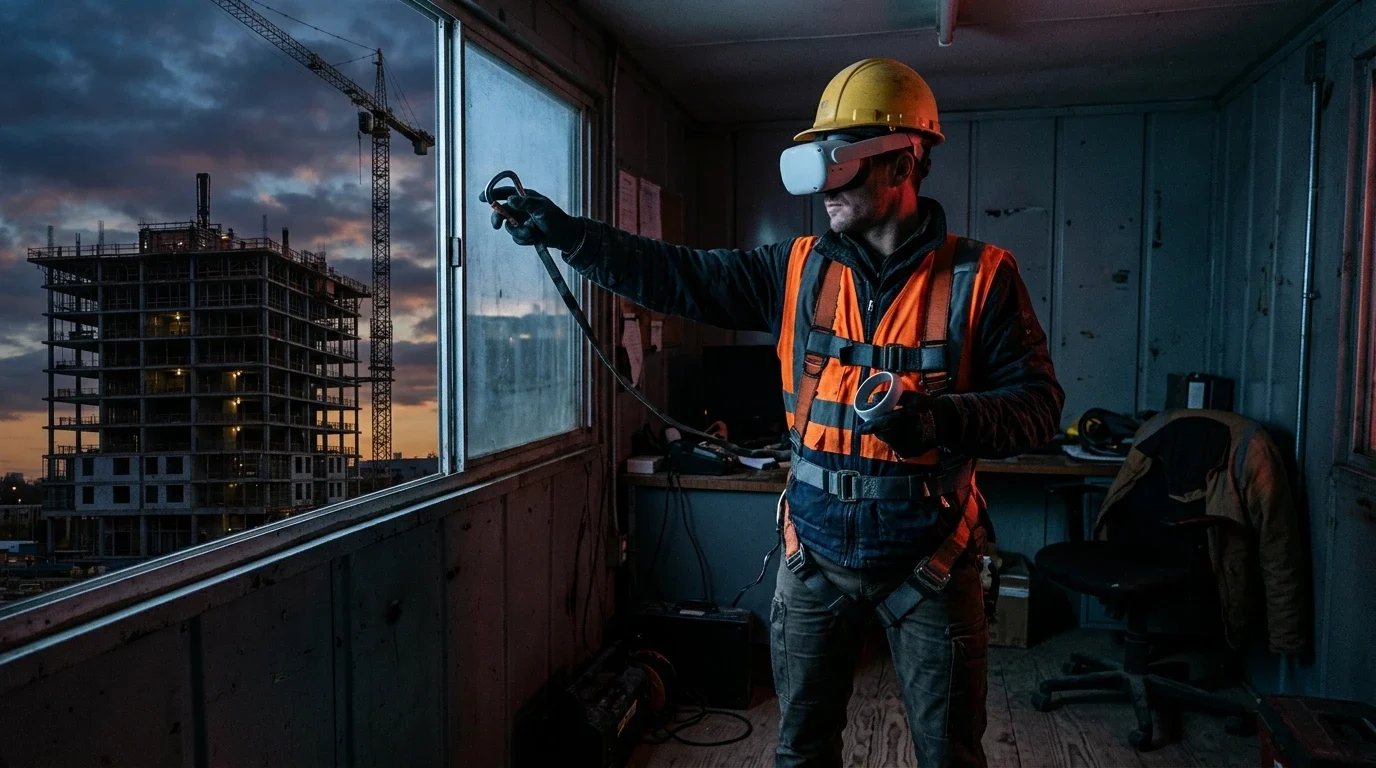
VR training lets construction workers practise dangerous tasks such as working at height, plant operation and excavation safety in a headset, which cuts equipment downtime, travel and the incidents caused by inexperience.
Construction companies spend heavily on training that happens in the worst possible place to learn: a live site. New workers learn to work at height, operate plant and spot hazards next to real drops, real machines and real deadlines. VR training moves the most dangerous part of that learning into a headset, where mistakes cost nothing and every trainee practises the same standard before they set foot on site.
This guide explains how construction firms use VR training to reduce training costs and incidents, which procedures deliver the fastest return, what a programme costs and how to run a pilot that proves the case to your board and your safety team.
Where it pays off first: working at height, scaffold inspection, plant and crane operation, excavation safety, confined spaces and site inductions.
How it cuts cost: no equipment taken out of production for practice, less travel to training centres, shorter inductions and fewer incidents caused by inexperience.
Typical investment: $15,000 to $25,000 for a pilot module, $35,000 to $75,000 for a multi-stage simulator, with standalone headsets at roughly $300 to $500 each.
Proof: every session records steps, errors and time taken, giving your safety team evidence that a worker has practised a procedure correctly.
1. Why Construction Training Is So Expensive
The visible cost of construction training is the course fee. The real cost is everything around it.
- Equipment downtime: an excavator, crane or telehandler used for training is not earning money on a project.
- Travel and lost days: workers travel to training centres and spend days off site, often during busy project phases.
- Supervision: experienced operators and supervisors spend hours watching trainees instead of running work.
- Inconsistent quality: the standard of on-the-job training depends on who is teaching and how busy the site is that day.
- Incidents: new and inexperienced workers are involved in a disproportionate share of site incidents, with costs that include investigations, delays, insurance and reputation.
VR does not remove the need for certified training or supervised experience. It reduces how much of that experience has to be gained the hard way.
2. The Construction Procedures That Suit VR Best
The best candidates share three traits: they are dangerous to practise for real, they are repeated by many workers, and mistakes have serious consequences.
Working at height
Trainees inspect harnesses, clip on to anchor points, move along edges and recognise unsafe scaffolding while standing safely on the ground. VR creates a genuine sense of height, which builds the habits that matter when the drop is real.
Fact check: falls remain the leading cause of work-related deaths in construction, accounting for more than 36.4% of all fatalities in the industry.
Source: CDC, National Institute for Occupational Safety and Health
Plant and crane operation
Operators practise pre-use checks, lifting plans, exclusion zones and signalling with a banksman. Simulated faults, overloads and ground conditions teach decisions that would be far too risky to rehearse on a real machine.
Hazard recognition and site inductions
New starters walk a virtual version of the site and identify hazards such as open excavations, unprotected edges, overhead power lines and poor housekeeping. Inductions become shorter and more consistent, and the score shows who needs more support.
Excavation and confined spaces
Workers learn shoring, atmosphere testing, entry permits and emergency response in scenarios that can include collapse or gas build-up, situations no one should experience for the first time underground.
Emergency response
Fire, injury and evacuation drills can run as often as needed without stopping work on site, and each worker experiences the scenario rather than watching a demonstration.
3. VR Training Compared With Traditional Construction Training
| Factor | Traditional site and centre training | VR training |
|---|---|---|
| Risk during practice | Real heights, machines and ground conditions | Zero physical risk |
| Equipment cost | Plant taken out of production | Virtual plant, available any time |
| Location | Training centre or a live site | Site cabin, office or depot |
| Failure scenarios | Described in a classroom | Experienced safely in the headset |
| Repetition | Limited by time and equipment | Unlimited practice until competent |
| Records | Attendance and sign-off sheets | Step-by-step scores and errors per worker |
Fact check: a 2024 meta-analysis of VR construction safety training found VR significantly more effective than traditional methods for safety behaviours, skills and experience, and recommended early use of VR for young, inexperienced workers.
Where VR does not replace site training
VR cannot reproduce weather, fatigue, real ground conditions or the physical effort of handling materials, and it does not replace certified courses or supervised hours on real plant. Treat it as preparation that makes on-site training safer and shorter, not as a substitute for it.
4. What VR Construction Training Costs
Costs follow the same bands as other enterprise VR training, which we break down in our guide to VR safety training costs and ROI.
- Pilot module: $15,000 to $25,000 over four to six weeks for one procedure, such as a scaffold inspection or a working-at-height routine.
- Multi-stage simulator: $35,000 to $75,000 for several procedures, custom plant models, failure scenarios and reporting.
- Multi-user and instructor-led programmes: $80,000 and up, for team scenarios such as lifting operations with an operator, slinger and supervisor.
- Hardware: standalone headsets at roughly $300 to $500 each, which need no PC and can travel between sites in a case.
The biggest saving on cost usually comes from existing data. If you have BIM models, CAD files for equipment or site drawings, they can be converted into the virtual environment far faster than modelling from photographs.
5. How to Run a Construction VR Pilot
- Pick one procedure with a clear cost. Choose the training that takes the most equipment time, the most travel, or causes the most near-misses.
- Involve a site supervisor from day one. They know where workers actually go wrong, and their approval makes adoption on site much easier.
- Measure before and after. Compare induction time, assessment scores and observed errors between a VR group and a traditional group.
- Keep sessions short. Fifteen to twenty minutes in the headset, followed by a debrief, works better than long sessions.
- Plan the rollout early. Decide how headsets will be stored, charged, cleaned and updated across sites before the pilot ends.
Start with site inductions or working at height. Both affect every new worker, both are expensive to deliver consistently, and both produce measurable results within weeks. Use the pilot data to build the case for plant and crane simulators, where the savings in equipment downtime are largest.
6. Frequently Asked Questions
Does VR training replace construction certification?
No. VR prepares workers before and between certified courses and supervised practice. It reduces the risk and cost of learning, while certification and on-site sign-off remain in place.
Can VR training use our own site and equipment?
Yes. Your BIM models, CAD files, drawings and photos can be used to recreate your plant, scaffolding systems and site layouts, so workers recognise what they will see on the job.
Do workers need to be comfortable with technology?
No. Modern standalone headsets use natural hand movements and simple controls. Most workers are comfortable within a few minutes, and a short guided tutorial at the start of each module helps first-time users.
How much does VR construction training cost?
A pilot module usually costs $15,000 to $25,000 and a multi-stage simulator $35,000 to $75,000, plus standalone headsets at roughly $300 to $500 each.
How quickly can we start?
A pilot module can usually be ready for trainees in four to six weeks after the procedure has been agreed.
Make Your Next Site Safer Before Work Starts
MEPROTECH builds VR training simulators for standalone headsets, including a warehouse logistics trainer for Meta Quest delivered in six weeks. We turn your procedures and engineering data into headset-ready scenarios, share a testable build every week for your supervisors to try, and hand over all source files and 3D assets at the end.
Explore our AR and VR development services, see how we build accurate 3D models of plant and equipment, or book a free call to plan a construction VR pilot.