Flutter vs React Native: Which Should Your App Use?
 By Miheer Jasani
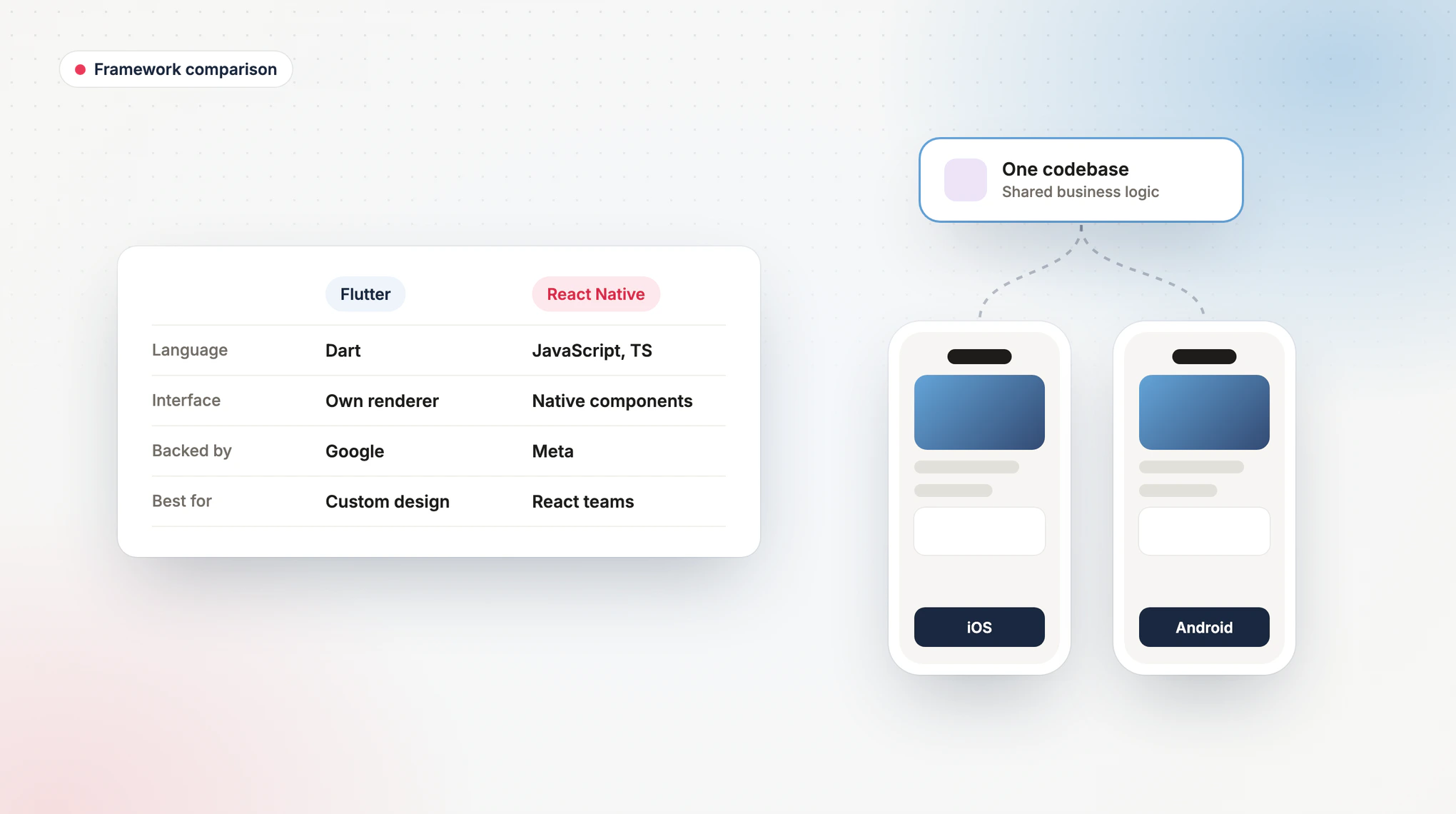
Flutter and React Native both build iPhone and Android apps from one codebase at a fraction of the cost of two native apps; choose Flutter when you want pixel-perfect custom design and consistent behaviour on every device, and React Native when your team already works in JavaScript or React and wants to share code with a web product. For most business apps, either will deliver an app users cannot tell apart from a fully native one.
This guide compares the two frameworks for the person paying for the app: cost, performance, design control, hiring and long-term risk, plus the cases where neither is the right answer. For budgets, see our guide to what a mobile app costs to build.
What they share: one codebase for iOS and Android, near-native performance and a large ecosystem, saving roughly the cost of a second app.
Choose Flutter for: highly custom, brand-led design, identical UI on every device, and apps that also target desktop or embedded screens.
Choose React Native for: teams with JavaScript or React skills, sharing logic with a React or Next.js web app, and apps that should look and feel like each platform's own.
Choose fully native for: heavy graphics, advanced AR, or deep use of the latest device hardware.
1. What Flutter and React Native Have in Common
Both frameworks let one team write one app that ships to the App Store and Google Play. That removes the biggest cost driver in mobile development, building and maintaining two separate apps. Both are free and open source, backed by large technology companies, used in production by thousands of businesses, and capable of camera access, maps, payments, notifications and offline storage.
2. Flutter and React Native Compared
| Factor | Flutter | React Native |
|---|---|---|
| Backed by | Meta | |
| Language | Dart | JavaScript or TypeScript |
| How the interface is drawn | Its own rendering engine draws every pixel | Uses each platform's native interface components |
| Design control | Identical look on every device, ideal for custom brands | Feels like each platform by default |
| Sharing code with a website | Possible, but web output suits apps more than content sites | Strong fit with React and Next.js web apps |
| Hiring | Growing pool of Dart developers | Very large pool of JavaScript and React developers |
| Other targets | Web, desktop and embedded devices | Web through shared React code, desktop through community projects |
Fact check: Flutter compiles Dart ahead of time into native machine code on Android and native ARM code on iOS. React Native made its rewritten New Architecture the default from version 0.76 and declared it ready for production.
Sources: Flutter documentation, FAQ and React Native blog, release 0.76
In practice, both deliver smooth scrolling and fast start-up for typical business apps. Performance differences show up mainly in animation-heavy interfaces and very large lists, and good engineering matters more than the framework.
3. When Flutter Is the Better Choice
- Brand-led design: custom interfaces, animations and components that must look exactly the same on every phone.
- Consistency across devices: fewer surprises from differences between Android manufacturers.
- Beyond phones: the same app on tablets, desktop or kiosk and embedded screens.
- A fresh team: no existing JavaScript investment to protect.
4. When React Native Is the Better Choice
- Existing web team: developers who know React can move to mobile quickly.
- Shared logic with a web product: validation, data handling and business rules shared with a React or Next.js web app, as in many SaaS products.
- Platform-native feel: standard iOS and Android controls that behave exactly as users expect.
- Hiring flexibility: the very large JavaScript talent pool.
5. What the Choice Means for Budget, Timeline and Risk
The framework rarely changes the size of the first quote by much. It changes what happens around it.
- Team ramp-up: a React team moving to React Native is productive within days. A team new to Dart needs a few weeks to reach full speed with Flutter.
- Design-heavy screens: custom animations and brand-led components are usually faster to build in Flutter, which draws every pixel itself.
- Shared web code: if a React or Next.js web app already exists, React Native can reuse validation, data handling and business rules, which shortens the mobile build.
- Third-party packages: both ecosystems are large. Check early that the payment, maps, analytics and login providers you need have well-maintained packages for your framework.
- Upgrades: both frameworks release regularly, and Apple and Google update their operating systems every year. Plan a small amount of upgrade work every few months rather than a large, risky upgrade every few years.
6. When Neither Is the Right Choice
Fully native development in Swift and Kotlin is worth its extra cost when an app depends on heavy graphics, advanced camera or AR features, or the newest device hardware on release day. Games and AR experiences are usually better built in a game engine, as we explain in Unity vs Unreal Engine. And if users only need occasional access, a web app may be enough; see web app vs mobile app.
Let your team and your web roadmap decide. If you already run a React web product or have JavaScript developers, choose React Native and share code. If you are starting fresh and design is central to your brand, choose Flutter. Either way, keep the business logic on your server so a future change of framework does not mean rebuilding everything.
7. Frequently Asked Questions
Is Flutter faster than React Native?
Flutter compiles to native code and draws its own interface, which gives very consistent animation performance. React Native's New Architecture closed much of the gap. For typical business apps, users will not notice a difference.
Which is cheaper to build with?
Costs are similar for most apps. React Native can be cheaper if you already have JavaScript developers or share code with a web app. Flutter can be cheaper for heavily customised designs.
Can we switch from one to the other later?
Only by rewriting the app's interface and much of its code. Keeping business logic and data on the server reduces the cost if you ever need to.
Do Flutter and React Native apps get approved on the App Store?
Yes. Both produce standard app packages that go through the normal App Store and Google Play review.
Which one does MEPROTECH use?
Both. We recommend one after looking at your design, your existing team and your web plans.
Build Your App on the Right Foundation
MEPROTECH builds iPhone and Android apps in Flutter and React Native, and web platforms in React and Next.js. Every project starts with a free call and a written quote, runs with a testable build every week, and ends with the source code transferred to you.
Explore our mobile app development services and web platform development, or book a free call to choose the right framework.