The VR Development Process: 6 Stages Explained
 By Miheer Jasani
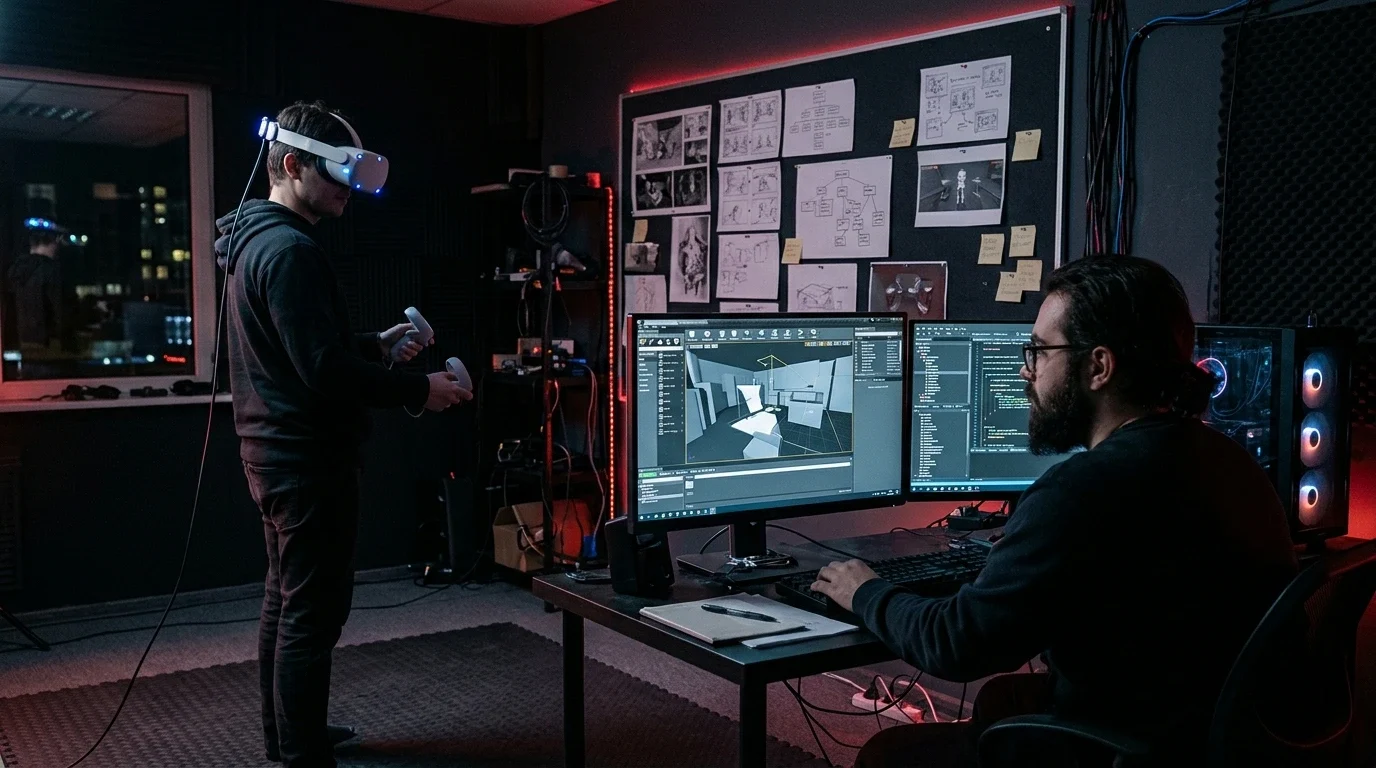
Virtual reality development follows six stages: discovery, interaction prototype, 3D art, production, testing, and launch with ongoing support. Most business VR projects move from idea to a launch-ready build in three to six months, and the projects that stay on time and on budget are the ones that test in a headset from the first weeks rather than at the end.
This guide walks through the VR development process step by step, from the perspective of the business funding the project. It explains what happens at each stage, what you should review, how long each stage takes and where VR projects most often go wrong. For the skills and tools involved, see our guide to what VR development is.
Six stages: discovery, interaction prototype, 3D art and environment, production, testing and optimisation, and launch with ongoing support.
Timeline: a focused pilot takes 4 to 6 weeks. A full application or VR game typically takes 3 to 6 months.
Budget: pilots usually cost $15,000 to $25,000, full single-user applications $35,000 to $75,000, and multi-user experiences $80,000 and up.
Biggest risk: discovering comfort, performance or usability problems late. Weekly headset builds prevent it.
1. Discovery and Goals
Every successful VR project starts with a clear answer to one question: what should the user be able to do, or understand, after using this? That could be completing a safety procedure, understanding a product, practising a sales conversation or enjoying a game.
During discovery the team agrees:
- The target audience and how often they will use the experience.
- The headsets it must run on, which shapes performance limits and cost.
- The core interactions, scenes and success measures.
- The assets you already own, such as CAD files, brand guidelines or procedure documents.
What you get: a written scope, a list of scenes and interactions, a timeline and a fixed quote or estimate. Typical length: one to two weeks.
2. Interaction Prototype
Before investing in detailed art, the team builds a rough but working prototype of the core interaction in a headset. Grey boxes stand in for final models. The point is to prove that the experience feels natural and comfortable.
This is the most valuable stage in VR development. Questions such as how users move, how they pick things up, how far they need to reach and whether anyone feels motion sickness are answered here, cheaply, rather than after weeks of art production.
What you review: a headset build you can try yourself. Typical length: one to three weeks.
Fact check: in a study of 92 adults using VR for ten minutes, 65.2% experienced cybersickness and 23.9% experienced it severely, and it had a substantial negative effect on their experience and willingness to adopt VR.
3. 3D Art and Environment Design
Once the interaction feels right, artists build the world: environments, equipment, products, characters and effects. VR art has stricter limits than film or rendering, because standalone headsets must draw every frame twice, once for each eye, at a high and steady frame rate.
Good VR art balances realism with performance through careful polygon budgets, efficient textures and baked lighting. Converting existing CAD or BIM data into optimised models is often faster than modelling from scratch, which is where our 3D modelling team saves clients time.
What you review: model turntables and in-headset scene walkthroughs. Typical length: runs alongside production, three to eight weeks.
4. Production
Developers build the full experience: every scene, interaction, user interface, audio cue, scoring rule and data connection. For training, this includes failure scenarios and reporting. For VR games, it includes levels, progression and game balance. For multi-user experiences, it includes networking, voice and session management.
Production runs in short sprints, with a new headset build every week so you can see progress and give feedback while changes are still cheap.
What you review: weekly builds and a progress update against the scope. Typical length: six to sixteen weeks depending on scope.
5. Testing and Optimisation
VR testing goes beyond finding bugs. The team checks:
- Comfort: no stutter, sudden movement or awkward reaching that causes discomfort.
- Performance: a steady frame rate on the lowest-spec target headset.
- Usability: first-time users can complete the experience without help.
- Store requirements: if the app is published on a headset store, it must pass that store's technical review.
Typical length: one to three weeks, with testing also running throughout production.
6. Launch and Ongoing Support
Launch may mean publishing to a headset store, distributing privately through device management to company headsets, or installing at an event or showroom. After launch, plan for updates as headset software changes, content is refreshed and users ask for new features. A common planning figure is 15% to 20% of the build cost per year.
The VR Development Process at a Glance
| Stage | Main output | Typical length | Your role |
|---|---|---|---|
| Discovery | Scope, scene list, timeline and quote | 1 to 2 weeks | Share goals, users and existing assets |
| Interaction prototype | Grey-box headset build of the core interaction | 1 to 3 weeks | Try it and confirm it feels right |
| 3D art and environments | Optimised models, scenes and effects | 3 to 8 weeks | Approve look and accuracy |
| Production | Full experience, built in weekly increments | 6 to 16 weeks | Review weekly builds |
| Testing and optimisation | Comfortable, stable, store-ready build | 1 to 3 weeks | Run user testing with real users |
| Launch and support | Published app and update plan | Ongoing | Roll out and gather feedback |
When VR Is the Wrong Choice
A clear process cannot rescue the wrong medium. If users need to see their surroundings, a phone-based AR or a browser 3D experience is often better. If the audience is large and has no headsets, a browser-based 3D experience reaches more people for less. Choose VR when presence, scale or safe practice is the point.
Insist on trying a headset build within the first three weeks. If a development partner cannot show you the core interaction working in a headset early, the project is carrying risk that will surface later as delays and rework. Early headset testing is the single best predictor of a VR project that lands on time.
Frequently Asked Questions
How long does VR development take?
A focused pilot takes four to six weeks. A complete single-user application or VR game usually takes three to six months, and multi-user experiences take longer because of networking and testing.
How much does VR development cost?
Pilots typically cost $15,000 to $25,000, full single-user applications $35,000 to $75,000, and multi-user experiences $80,000 and up. Our VR app cost guide breaks these figures down.
What do we need to provide to start?
A clear goal, access to the people who know the subject, and any existing assets such as CAD files, procedures, brand guidelines or reference photos. The discovery stage turns these into a scope.
Is the process different for VR games?
The stages are the same, but games spend more time on level design, game balance and playtesting, and less on integrations and reporting.
Can one VR app run on several headsets?
Yes, if it is planned from the start. Our guide to cross-platform XR development explains how to target several headsets with one project.
Start Your VR Project With a Clear Plan
MEPROTECH builds VR training simulators, browser-based WebXR experiences and our own VR games for Meta Quest, such as Peak Fall. Every project starts with a free call and a written quote, runs with a testable build every week, and ends with all source files and 3D assets transferred to you.
Explore our AR and VR development services and game development services, or book a free call to plan your VR project.