How Much Does a Business Website Cost in 2026?
 By Miheer Jasani
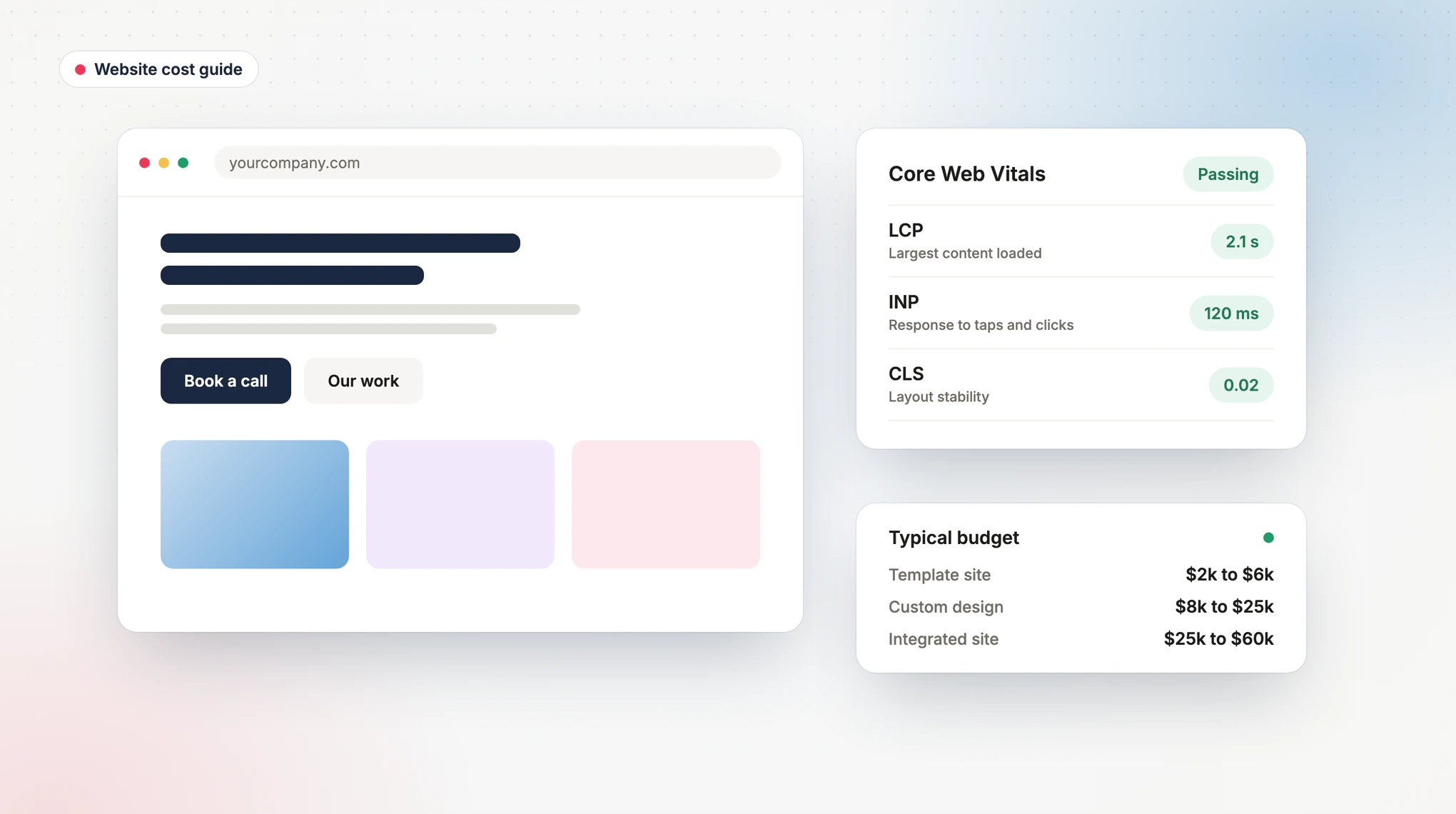
A professional small business website built on a template usually costs $2,000 to $6,000, a custom-designed marketing website $8,000 to $25,000, a content-heavy site with integrations $25,000 to $60,000, and an online store from $15,000 depending on products and integrations. The price is driven by design depth, the number of page types, how content is managed, and what the site must connect to.
This guide explains what each level of website includes, where the budget goes, the running costs after launch, and how to make sure the site you pay for is fast enough to win customers. If you need logins, dashboards or subscriptions, you are building a web application instead, which our SaaS development cost guide covers.
Template-based business website: $2,000 to $6,000 over 2 to 4 weeks. Five to ten pages on a proven theme.
Custom-designed marketing website: $8,000 to $25,000 over 4 to 8 weeks. Bespoke design, content system, analytics and strong performance.
Content-heavy or integrated website: $25,000 to $60,000 over 2 to 4 months. Many page types, multiple languages, CRM and booking integrations.
E-commerce website: $15,000 to $80,000 and up, depending on catalogue size, payments and integrations.
Running costs: hosting, domain, licences and maintenance, typically 10% to 20% of the build cost per year.
1. Website Cost by Type
| Website type | What you get | Typical budget | Timeline |
|---|---|---|---|
| Template-based business site | Five to ten pages on a proven theme, contact forms, basic SEO | $2,000 to $6,000 | 2 to 4 weeks |
| Custom marketing website | Bespoke design, reusable page sections, content system, analytics | $8,000 to $25,000 | 4 to 8 weeks |
| Content-heavy or integrated site | Many page types, multiple languages, CRM, booking and search | $25,000 to $60,000 | 2 to 4 months |
| E-commerce website | Catalogue, checkout, payments, shipping and stock integrations | $15,000 to $80,000 and up | 1 to 5 months |
These ranges are budgeting bands for a professional studio, not quotes. A short discovery call that lists your pages, content and integrations turns a range into a fixed number.
2. What Drives the Cost of a Website
Design depth
A template gets you online quickly. A custom design built around your brand, your buyers and your offer costs more, but it is usually what separates a site that generates enquiries from one that only exists. See our guide to UI and UX design that improves conversions.
Page types, not page count
Twenty service pages built from one template cost little more than five. Each new kind of page, such as case studies, location pages, a blog or a pricing calculator, needs its own design and build.
Content management
A content system lets your team edit text, images and posts without developers. Multiple languages, approval workflows and many editors add scope.
Integrations
Each connection to a CRM, booking tool, payment provider, email platform or inventory system adds design, testing and maintenance.
Speed, SEO and accessibility
Fast loading, clean structure for search engines and accessibility for all visitors should be in every quote. Fixing them after launch costs far more than building them in.
Fact check: Google's Core Web Vitals define a good experience as Largest Contentful Paint within 2.5 seconds, Interaction to Next Paint of 200 milliseconds or less, and Cumulative Layout Shift of 0.1 or less, measured at the 75th percentile of page loads on mobile and desktop.
Source: web.dev, Web Vitals
Ask for these targets in writing as part of your quote. Our guide to why slow websites lose sales explains what is at stake.
3. Running Costs After Launch
- Hosting and domain: from a few dollars to a few hundred dollars a month depending on traffic and performance needs.
- Licences: premium themes, plugins, fonts, forms and booking tools often carry annual fees.
- Maintenance: security updates, backups, small changes and fixes, typically 10% to 20% of the build cost per year.
- Content: new pages, case studies and blog posts keep the site useful to visitors and search engines.
4. What a Professional Website Quote Should Include
Two quotes for "a website" can describe very different projects. Before you compare prices, check that each one states:
- The page types and templates being designed and built, not just a page count.
- Who writes the content and who supplies images, and what happens if content arrives late.
- The content system your team will use, and whether training is included.
- Every integration, such as CRM, booking, payments or email, named individually.
- Performance and accessibility targets, written as measurable numbers.
- SEO set-up: page titles, descriptions, redirects from old URLs, a sitemap and structured data.
- Revision rounds, hosting set-up and support after launch, with any monthly costs.
- Ownership of the domain, hosting account, code and design files.
Missing redirects from an old site are one of the most common causes of lost search traffic after a redesign, so make sure they are in scope.
5. When a Website Builder Is Enough
If you need a simple online presence with a few pages, no integrations and no plans to grow traffic through search, a do-it-yourself website builder can be the sensible choice. A professionally built site pays off when the website is a real sales channel: when you rely on search traffic, run paid campaigns, need integrations, or sell high-value services where trust decides the sale.
6. How to Get More Website for Your Budget
- Write down your goals and buyers first. A clear brief prevents paying for pages nobody visits.
- Design page types, not pages. Reusable sections keep the build lean and let your team add pages later.
- Prepare content early. Late copy and images are the most common cause of delays.
- Put performance targets in the contract. Speed is far cheaper to build in than to fix.
- Own your accounts. Domain, hosting, analytics and the code or theme should be in your name.
Spend on the pages that sell: the home page, service pages and case studies. Build them on reusable sections with performance targets agreed in writing, then grow the site with content each month. A smaller, fast, focused site beats a large slow one for both visitors and search engines.
7. Frequently Asked Questions
How much does a small business website cost?
A professionally built small business website on a proven template usually costs $2,000 to $6,000. A custom-designed site typically costs $8,000 to $25,000.
How long does it take to build a website?
Template-based sites take two to four weeks, custom marketing sites four to eight weeks, and larger integrated sites two to four months.
What are the ongoing costs of a website?
Hosting, domain and licences, plus maintenance of roughly 10% to 20% of the build cost per year for updates, backups and small changes.
Should I choose a template or a custom design?
A template suits a tight budget and a simple offer. Choose custom design when the website is a main source of leads or sales and needs to stand out.
Is an e-commerce site more expensive?
Usually, yes. Catalogues, checkout, payments, shipping and stock integrations add significant scope, especially with many products or variants.
Get a Fixed Quote for Your Website
MEPROTECH designs and builds fast websites and web platforms in React and Next.js, with performance and SEO built in from the first sprint. Every project starts with a free call and a written quote, and ends with the code and accounts in your name.
Explore our web development services, see how we add AI automation to websites, or book a free call to plan your website.