How AI Tools in Unity Speed Up Game and VR Development
 By Miheer Jasani
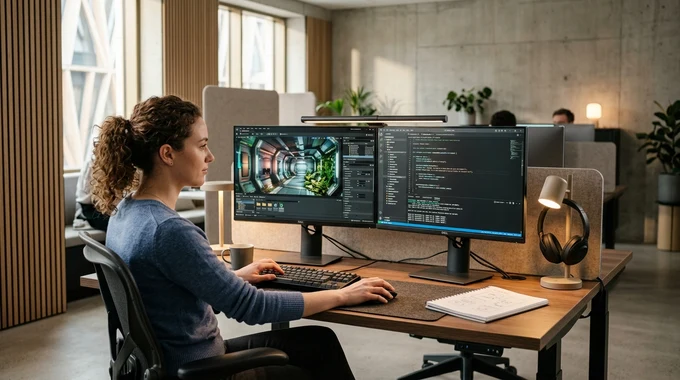
For decades, commercial game and simulation production required massive teams to manually configure scenes, rig character skeletons, write repetitive interface code, and run manual playtesting passes. Today, modern artificial intelligence workflows inside game engines like Unity are fundamentally transforming the production economics of building video games and immersive virtual reality experiences.
Rather than replacing human creativity, new engine tooling, command-line interfaces, and autonomous agent frameworks allow specialized engineering studios to achieve the production velocity of multi-million dollar studios while shortening development schedules.
Whether you are an indie founder launching a commercial title or an enterprise executive building an interactive simulation, partnering with an experienced Unity game development company that leverages modern AI automation ensures your project reaches market faster, stays strictly on budget, and delivers elite performance across platforms.
Accelerated Time-to-Market: Automated engine scripting and command-line execution reduce early-stage prototyping and scene setup times from weeks to days.
Predictable Production Costs: Routine asset variation, physics testing, and bug detection are automated, keeping studio milestone budgets on track.
Local On-Device Execution: Modern neural runtimes like Unity Sentis run intelligent non-player characters and adaptive logic directly on player hardware with zero cloud API latency and zero ongoing token fees.
Enterprise Studio Partner: Forward-thinking businesses hire a specialized custom game development company like MEPROTECH to turn cutting-edge engine automation into measurable commercial success.
1. Automated Engine Control and Headless Workflows
One of the most impactful breakthroughs in modern game engineering is the ability to control game engines through command-line interfaces (CLI) and automated pipelines. Instead of requiring human developers to manually click through menus to import assets, configure colliders, and setup build targets, automated systems can now configure scenes and compile platform builds programmatically.
- Continuous Automated Builds: Headless continuous integration pipelines build, package, and verify cross-platform mobile, PC, and VR versions overnight without manual intervention.
- Automated Scene Assembly: Procedural tools arrange levels, place lighting probes, and verify bounding boxes in seconds based on high-level design parameters.
- Live Script Verification: Engine automation verifies component dependencies and physics boundaries before engineers begin manual balance reviews.
- Autonomous Project Maintenance: Repetitive tasks such as dependency updates, asset bundle compression, and multi-resolution texture baking execute continuously in the background.
2. Comparing Traditional Game Production vs. AI-Assisted Workflows
Understanding where modern automation creates real financial savings is essential for studio heads, startup founders, and corporate innovation teams planning a new title:
| Production Milestone | Traditional Studio Process | Modern AI-Assisted Process | Executive Commercial ROI |
|---|---|---|---|
| Playable Prototype (MVP) | 8 to 12 weeks of manual coding, greyboxing, and basic animation setup | 2 to 4 weeks using automated scene assembly and procedural logic | Lower pre-production risk, because ideas are tested before full production |
| Quality Assurance & Testing | Hundreds of hours of manual human testing across physical devices | Automated test bots simulating thousands of complete game sessions | Early detection of game-breaking exploits and progression blockers |
| Character & Enemy Logic | Complex, rigid decision trees that take weeks to rebalance | Neural models and dynamic state controllers trained for adaptive difficulty | Higher player retention and longer average session lengths |
| Asset Optimization & Level LODs | Days spent manually decimating meshes and baking normal maps | Automated mesh retopology, LOD generation, and texture compression | Optimized frame rates on mobile and standalone VR headsets |
| Multi-Platform Porting | Months of manual recompilation and performance retuning per platform | Automated multi-platform packaging and graphics shader adjustments | Simultaneous launch across iOS, Android, PC, and VR |
3. Intelligent Characters and On-Device Neural Networks
Early attempts at bringing artificial intelligence into games relied on connecting to remote cloud servers. This created two critical dealbreakers for commercial releases: noticeable network latency and unpredictable monthly API bills that ate away at studio revenue.
The industry has shifted decisively toward on-device neural runtimes, such as Unity Sentis. By packaging lightweight neural network models directly into the compiled game executable, non-player characters and reactive game systems run directly on the player's smartphone, console, or VR headset.
- Zero Cloud Latency: Characters react instantly to player actions and environmental changes without waiting for server responses.
- Full Offline Functionality: Players can enjoy the complete narrative and intelligent character interactions without an active internet connection.
- Zero Ongoing Token Fees: Game publishers pay no recurring per-query server fees, preserving profit margins on live-service and one-time purchase titles.
- Strict Narrative Guardrails: Intelligent characters remain firmly grounded within your game's lore, preventing unwanted or out-of-character dialogue.
4. Automated Playtesting: Catching Game-Breaking Bugs Early
For commercial game creators and corporate simulation builders, launch day bugs can permanently destroy player reviews and commercial reputation. Automated playtesting agents can play through levels millions of times overnight, testing edge cases that no human QA team could cover in months.
- Physics Stress Testing: Bots probe every wall, ledge, and collision boundary to verify that players cannot get stuck or clip through level geometry.
- Economy and Difficulty Balance: Automated simulations identify points where in-game currency becomes too scarce or bosses become mathematically unwinnable.
- Device Performance Profiling: Automated testing tracks frame rates, memory spikes, and thermal throttling across dozens of device configurations simultaneously.
- Exploit Discovery: Reinforcement learning agents discover sequence breaks and unintended speedrun skips before competitive players can exploit them online.
Related reading: The Best Tools for Unity Game Development in 2026, How Games Use AI in 2026: Characters, Worlds and Tools and How to Turn a Game Idea Into a Profitable Business.
5. Why Choose MEPROTECH for Your Game & AI Development
Navigating modern game engines, spatial computing frameworks, and automated development pipelines requires a partner with deep real-time engineering expertise. MEPROTECH is an elite full-cycle engineering studio delivering high-performance digital solutions across gaming, immersive technology, and enterprise software.
Here is why founders, enterprises, and gaming studios trust MEPROTECH as their development partner:
- End-to-End Game Production: From early concept ideation and technical design documents to custom 3D asset modeling, C# mechanics architecture, and store deployment, we handle the complete lifecycle.
- Advanced Unity & VR Specialization: Our senior engineers have built and shipped commercial games, industrial simulations, and educational applications across iOS, Android, Steam, Meta Quest, and Apple Vision Pro.
- Pioneering AI & Automation Pipelines: We integrate headless CLI build workflows, automated QA testing, and on-device neural runtimes to reduce client project costs while maintaining premium visual polish.
- Transparent Milestone-Based Delivery: We work in predictable sprint phases with clearly defined deliverables, live playable builds at every milestone, and zero hidden agency overhead.
- Intellectual Property Security: You retain 100% ownership of your game design, source code, 3D assets, and repository from day one.
6. Frequently Asked Questions
Can AI build a complete video game on its own?
No. While AI can write individual code snippets and generate concept art, it cannot design cohesive game mechanics, architect scalable multiplayer backends, or fine-tune player psychology. Commercial success requires senior game designers and software engineers who use AI as a high-speed productivity tool.
How does MEPROTECH use AI to lower game development costs?
We use automated engine scripts and headless command-line tools to automate repetitive tasks like level asset placement, collision verification, mesh retopology, and automated playtest sweeps. This allows our engineers to spend their time on core gameplay mechanics and visual refinement, cutting production schedules by weeks.
What platforms can MEPROTECH build games for?
We build cross-platform titles for mobile (iOS and Android), PC (Steam and Epic Games Store), standalone VR (Meta Quest and Pico), spatial computing (Apple Vision Pro), and interactive WebGL for web browsers.
How do we start a game development project with MEPROTECH?
Getting started is simple. Contact our team to schedule a technical discovery call. We review your concept, define the scope, recommend the ideal architecture, and provide a transparent, milestone-driven development proposal.
Partner with MEPROTECH to engineer your next commercial game, interactive simulation, or spatial application with industry-leading speed and polish.
Ready to accelerate your game production? Explore our custom game development services or schedule a free technical consultation with MEPROTECH today.