How Much Does It Cost to Make a Game in 2026?
 By Miheer Jasani
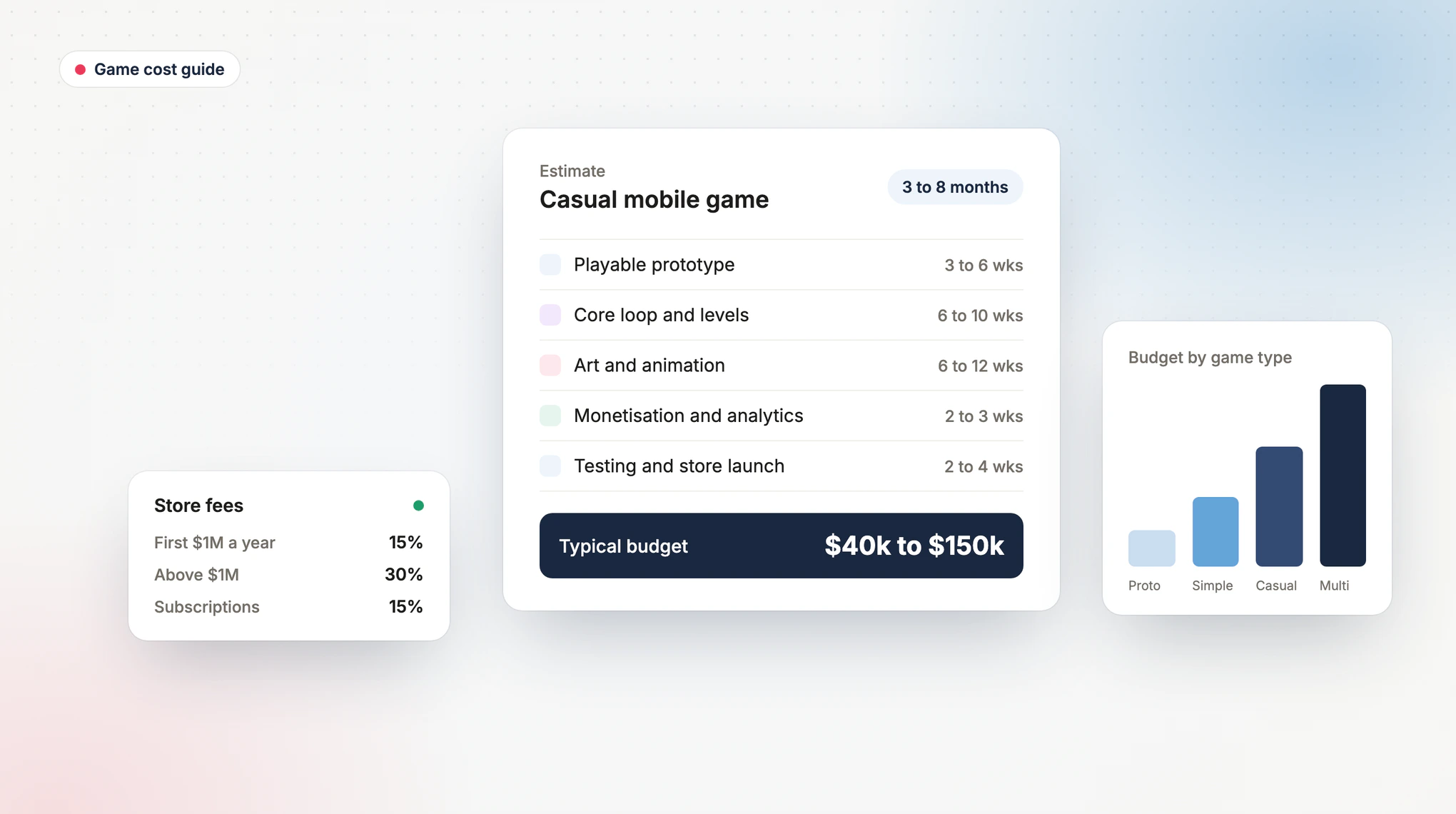
A simple mobile game usually costs between $15,000 and $40,000 to build, a polished casual game with progression and in-app purchases costs $40,000 to $150,000, and multiplayer or mid-core games start around $150,000. The genre matters less than four decisions: how much content you launch with, how detailed the art is, whether players connect to each other online, and how the game makes money.
This guide breaks down what each type of game typically costs, where the budget goes, the costs that continue after launch, and how to keep the first release small enough to test with real players. If you are still shaping the concept, start with our guide to turning a game idea into a profitable business.
Playable prototype: $5,000 to $15,000 over 3 to 6 weeks. The core mechanic, one level and placeholder art, built to prove the game is fun.
Simple mobile game: $15,000 to $40,000 over 1 to 3 months. One core loop, simple progression, ads or a single purchase.
Casual mobile game: $40,000 to $150,000 over 3 to 8 months. Levels, progression, in-app purchases, analytics and live updates.
VR game for standalone headsets: $35,000 to $150,000 over 3 to 9 months, depending on interactions and content.
Multiplayer or mid-core game: $150,000 and up over 9 to 18 months, with servers and live operations on top.
1. What Drives the Cost of a Game
Two games with the same one-line pitch can differ in cost by a factor of five. These are the decisions that move the number most.
Content volume
Every level, character, item and mission needs design, art, testing and balancing. A game with ten polished levels and a clear loop costs far less than one with a hundred levels and a story. Launch with enough content to keep players for a week, then add more based on what they actually play.
Art style
Art is often the largest single line in a game budget. Clean, stylised 2D or low-poly 3D art is fast to produce and runs well on low-cost phones. Realistic 3D characters, detailed environments and complex animation multiply the cost and the time. Choose the style that suits your audience, not the one that looks most impressive in a pitch deck.
Online features
Single-player games run entirely on the device. Leaderboards, cloud saves and friend invites add a modest back end. Real-time multiplayer is a different scale of project: servers, matchmaking, cheating prevention and testing with many players at once. It is the single biggest cost step in game development.
Monetisation and analytics
Ads, in-app purchases and subscriptions each need integration, store setup, testing and balancing so that paying feels fair. Analytics are not optional: without them you cannot tell where players leave or what they buy.
Platforms
Building for iOS and Android from one engine project adds testing and store work, not a second game. Adding VR headsets, PC or consoles brings new controls, performance targets and certification steps.
2. Game Development Cost by Type
| Game type | Typical scope | Typical budget | Timeline |
|---|---|---|---|
| Playable prototype | Core mechanic, one level, placeholder art | $5,000 to $15,000 | 3 to 6 weeks |
| Simple mobile game | One core loop, simple progression, ads or one purchase | $15,000 to $40,000 | 1 to 3 months |
| Casual mobile game | Levels, progression, in-app purchases, analytics, live updates | $40,000 to $150,000 | 3 to 8 months |
| VR game | Physics-based interactions, comfort tuning, headset store release | $35,000 to $150,000 | 3 to 9 months |
| Multiplayer or mid-core game | Real-time multiplayer, accounts, economy, live operations | $150,000 and up | 9 to 18 months |
These ranges assume a small, experienced team building in a mature engine. Treat them as budgeting bands, not quotes. For VR-specific budgets, see our guide to the cost of building a VR app.
3. The Costs That Continue After Launch
Launch is the start of a game's spending, not the end. Plan for these from day one.
- Store fees: app stores keep a share of what players spend on downloads, purchases and subscriptions.
- Live operations: new levels, events, balance changes and bug fixes keep players coming back. Most successful mobile games ship updates every few weeks.
- Servers: online games pay for hosting that grows with the number of players.
- Player acquisition: marketing to find players often costs as much as development, sometimes more. A game nobody finds earns nothing.
- Platform updates: new phone and operating system versions require regular technical updates to stay listed.
Fact check: Google Play charges a 15% service fee on the first $1M (USD) a developer earns each year in the 15% tier, rising to 30% above that, and 15% on automatically renewing subscriptions.
4. When a Custom Game Is Not the Right Investment
A custom game is a poor fit if there is no budget to reach players after launch, if the goal is a short marketing campaign that a simple browser mini-game could serve, or if the concept has not yet been tested with a prototype. In each case, spend a small amount proving the idea before committing to full production.
5. How to Keep Your Game Budget Under Control
- Prototype the core loop first. If the first 30 seconds are not fun with placeholder art, better art will not fix it.
- Choose an engine your team knows. Our comparison of Unity and Unreal Engine explains which suits which project.
- Launch small and update often. A focused first release with analytics teaches you more than a large launch built on guesses.
- Pick the right contract. Fixed milestones suit a well-defined game; time and materials suit open-ended live games. See fixed price vs time and materials.
- Own everything. Source code, art files and store accounts should be in your name from the start.
Spend the first 10% of your budget on a playable prototype and put it in front of real players. Measure whether they understand the game without help and whether they play a second session. Only then fund production, with monetisation and analytics built in from the first release rather than added later.
6. Frequently Asked Questions
How much does it cost to make a simple mobile game?
Typically $15,000 to $40,000 for a game with one core loop, simple progression and ads or a single purchase, built over one to three months.
How long does it take to develop a game?
Simple mobile games take one to three months, casual games with progression three to eight months, and multiplayer games nine months or more.
Is it cheaper to build a 2D game than a 3D game?
Usually, yes. 2D art and animation are faster to produce, and 2D games run well on a wider range of phones. Stylised low-poly 3D can come close in cost.
Should my first game include multiplayer?
Rarely. Multiplayer multiplies cost and risk. Launch a strong single-player game with leaderboards, then add multiplayer once you know players are staying.
Who owns the game when a studio builds it?
You should. Make sure the contract assigns all code, art and design files to you, and that store accounts are created in your name.
Get a Clear Number for Your Game
MEPROTECH builds mobile and VR games and publishes its own titles on Google Play and Meta Quest, including Peak Fall and Cup Clash VR. Every project starts with a free call and a written quote, runs with a testable build every week, and ends with the source code and art transferred to you.
Explore our game development services, see our VR game work, or book a free call to scope your game.