How to Hire Unity Developers: Options, Costs and Checks
 By Miheer Jasani
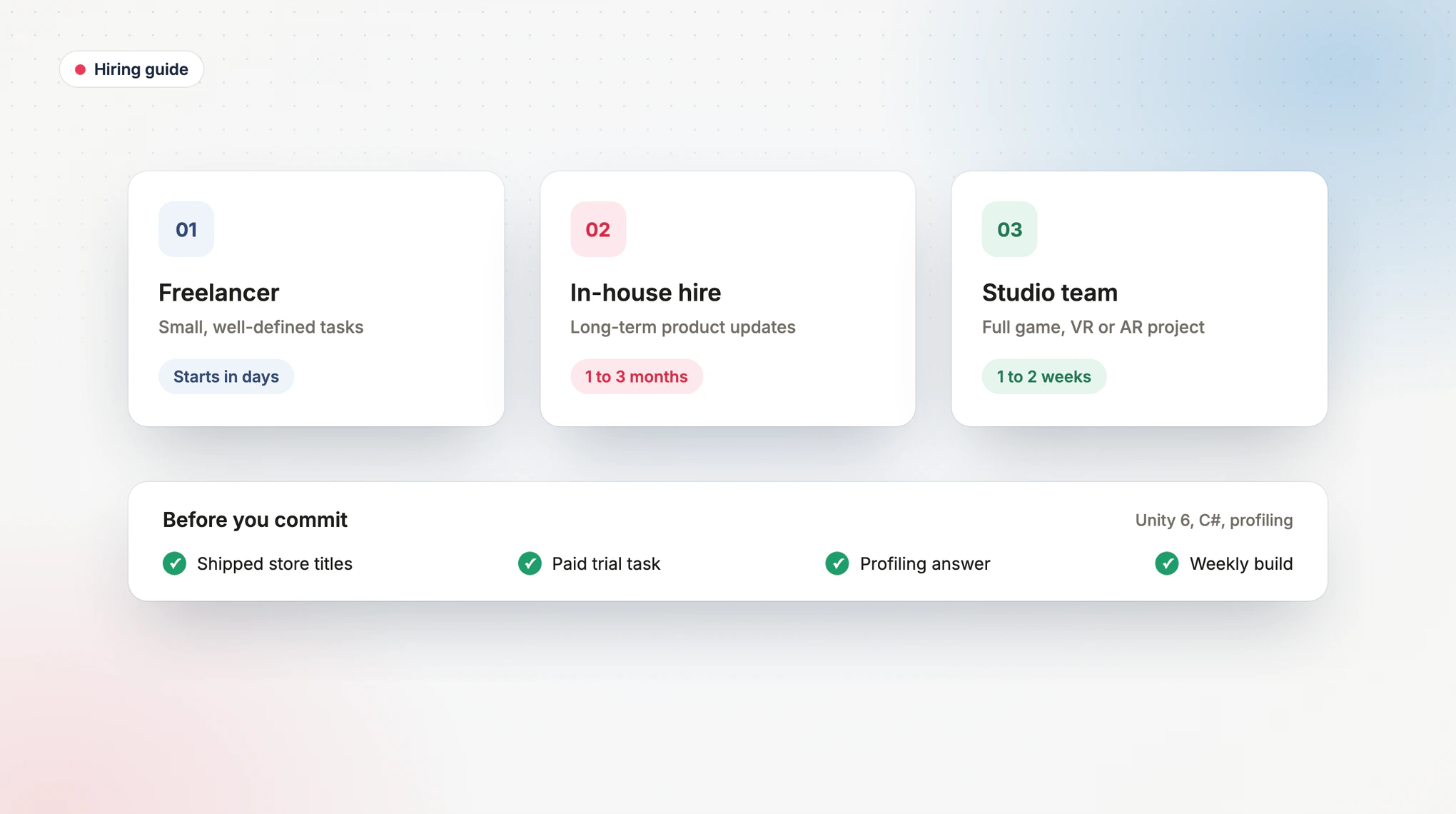
You can hire Unity developers in three ways: a freelancer for small, well-defined tasks, an in-house hire for long-term products, or a dedicated studio team when you need a full game, VR or AR project delivered with design, art and testing included. The right choice depends on how long the work lasts, how many skills it needs and how much management time you can give it.
This guide compares the three hiring models, explains which Unity skills actually matter for your type of project, shows how to test a developer before you commit, and lists the warning signs to watch for. If you are also comparing locations, read our guide to outsourcing software development to India.
Freelancer: fastest to start and cheapest for small tasks, but you manage the work and carry the risk if they leave.
In-house hire: best for a long-term product, but slow to recruit and you still need artists, designers and testers.
Dedicated studio team: a complete team from day one with one point of accountability. Experienced teams in India typically charge $25 to $60 an hour.
Best test: a short paid task plus a look at games or apps they have shipped to real stores.
1. Three Ways to Hire Unity Developers
| Model | Best for | Speed to start | Main risk |
|---|---|---|---|
| Freelancer | Bug fixes, a single feature, a prototype | Days | Availability, no backup if they leave, you manage quality |
| In-house hire | A long-running product with constant updates | 1 to 3 months to recruit | Hiring cost, gaps in art, design and testing skills |
| Dedicated studio team | A full game, VR or AR project from idea to launch | 1 to 2 weeks | Choosing a studio without relevant shipped work |
Many companies combine models: a studio builds and launches the product, then an in-house developer takes over day-to-day updates with the studio on call. For how to structure the contract, see fixed price vs time and materials.
2. The Unity Skills That Actually Matter
"Knows Unity" covers a very wide range of ability. Match the skills to your project.
For every project
- C# and clean project structure: code that another developer can pick up without starting again.
- Performance profiling: the ability to find and fix why a game stutters or drains the battery.
- Version control: every change tracked in a shared repository you own.
For mobile games
- Optimisation for mid-range phones, ads and in-app purchase integration, analytics, and publishing to Google Play and the App Store.
For VR and AR
- Comfortable movement and interaction, steady frame rates on standalone headsets, hand tracking, and passing headset store reviews. Our guide to the VR development process explains why early headset testing matters.
For training and simulation
- Turning procedures into steps and scoring, importing CAD models efficiently, and reporting results to other systems.
Fact check: Unity runs official certification exams at User, Associate and Professional levels, with tracks for programmers and artists and a Certified User exam for VR developers.
Source: Unity, certifications
Certification is a useful signal for junior developers. For senior developers, shipped products on real stores tell you far more.
3. How to Test a Unity Developer Before You Commit
- Play what they have shipped. Download their games or apps from the store and try them on an ordinary phone or headset, not just a video.
- Run a short paid task. One to three days on a real piece of your project shows code quality, communication and speed better than any interview.
- Ask a performance question. "This scene drops frames on a mid-range phone. How would you find out why?" Experienced developers answer with specific steps.
- Review their code with someone technical. If you are not technical, pay an independent developer for an hour of review.
- Check how they report progress. You should see a working build at least every week.
4. What a Good First Month Looks Like
Whoever you hire, the first four weeks tell you whether the arrangement will work. This is what to expect from an experienced Unity developer or team.
- Week 1: access to a repository in your name, a short technical plan, target devices agreed, and questions about your players, budget and launch date.
- Week 2: a first playable build on a real phone or headset, even if the art is placeholder.
- Week 3: the core mechanic working end to end, with a list of risks and how they will be handled.
- Week 4: a build with the first real art, a frame-rate check on your lowest target device, and a plan for the next milestone.
If you reach the end of the first month without a playable build on your own device, raise it immediately. It rarely improves on its own.
5. Warning Signs to Watch For
- No published games or apps you can download and try.
- Reluctance to put the project in a repository you own.
- Weeks without a playable build.
- Quotes far below every other quote with no clear reason.
- No questions about your target devices, audience or monetisation.
6. When You Do Not Need a Unity Developer
Unity is a game and real-time 3D engine. A business app with forms and dashboards is better built with a mobile framework, as we explain in Flutter vs React Native. A simple 3D product viewer on a website is often lighter with web 3D libraries. And if photorealistic PC visuals are the goal, compare engines first in our guide to Unity vs Unreal Engine.
For a first game, VR or AR product, hire a dedicated team that includes design, art and testing, and insist on a weekly build and a repository in your name. Once the product is live and the roadmap is steady, consider bringing a developer in-house to own day-to-day updates, with the original team available for larger features.
7. Frequently Asked Questions
How much does it cost to hire a Unity developer?
Rates vary widely by country and seniority. Experienced Unity teams in India typically charge $25 to $60 an hour. Rates in North America and Western Europe are considerably higher.
Should I hire a freelancer or a studio?
A freelancer suits small, well-defined tasks. A studio suits complete projects that need design, art, development and testing together, with one team accountable for delivery.
How long does it take to hire a Unity developer?
A freelancer or studio can usually start within one to two weeks. Recruiting an experienced in-house developer often takes one to three months.
Do I need a Unity developer for a VR app?
For most VR apps on standalone headsets, yes. Unity is widely used for VR training, VR games and AR. Look for developers who have shipped to headset stores.
Who owns the code when I hire an outside team?
You should. The contract should assign all code and assets to you, and the repository should be created in your account from the start.
Work With a Team That Ships Unity Projects
MEPROTECH's team builds in Unity 6 for mobile, VR and the browser. Our VidyaXR modules run in a browser and in a headset from one project, we publish our own games on Google Play and Meta Quest, and our VR logistics training simulator was delivered in six weeks. Every engagement includes a weekly build and a repository in your name.
Explore our game development services and AR and VR development, or book a free call to discuss your Unity project.